
Blog / 2026-10-05
Building My Own Social Media Hub
Why I started building my own social media management hub, how Facebook and Instagram publishing work today, and how I’m using AWS to add reliable scheduling and automation.
I didn’t set out to reinvent social media management. There are already plenty of tools that let you manage multiple accounts, schedule posts, and keep content in one place. But every time I looked at one, I seemed to run into another subscription, another paywall, or a workflow that didn’t quite fit how I wanted to work.
At some point I realized: this is literally the kind of thing I build.
A big part of my work is creating applications that solve workflow problems. So instead of adding another third-party tool to my stack, I decided to start building my own. Then I have full control to adjust to my workflow.
One Piece of Content, Multiple Channels
The main idea is pretty straightforward. I want one central hub where I can create a core piece of content and then use that content across multiple platforms.
Instead of starting from scratch every time I need a Facebook post, Instagram post, LinkedIn update, Google Business update, or eventually even a blog post, I can start with one master piece of content.
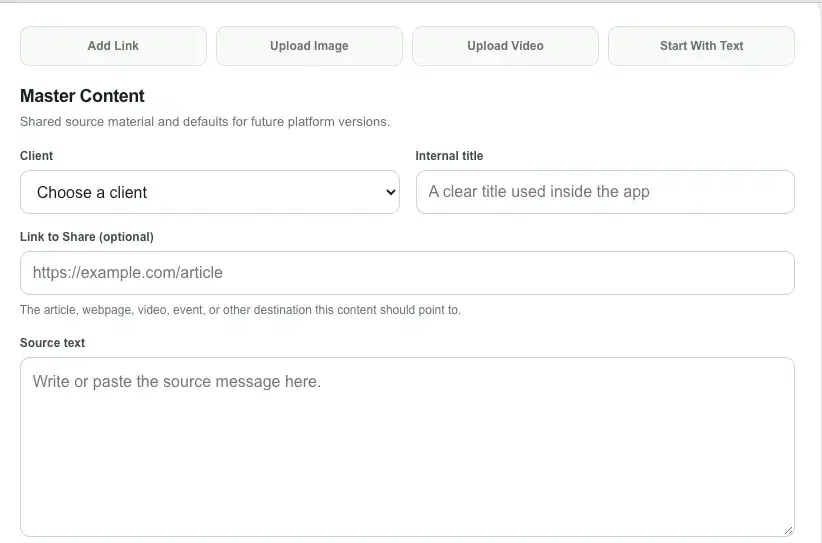
From there, the hub can adapt that content for the places where it needs to go. That also gives me one place to manage content for multiple clients instead of constantly jumping between platforms and accounts.
Eventually, I’d like to be able to sit down for a focused block of time, build out several weeks—or even a month—of content, schedule everything, and then spend the rest of my time on other work.
Getting the Platforms Connected
Of course, the idea is the easy part. Getting all of these platforms to actually talk to each other has been much more interesting. LLM is helpful in this process... but it is still quite the lift.
Connecting to the social APIs has involved plenty of trial and error, authentication issues, permissions, account connections, and figuring out exactly what each platform will and won’t allow.
But that’s also been one of the more satisfying parts of building it.
Right now, I have Facebook and Instagram connected, and I’ve already connected multiple accounts and published real posts directly through the hub.
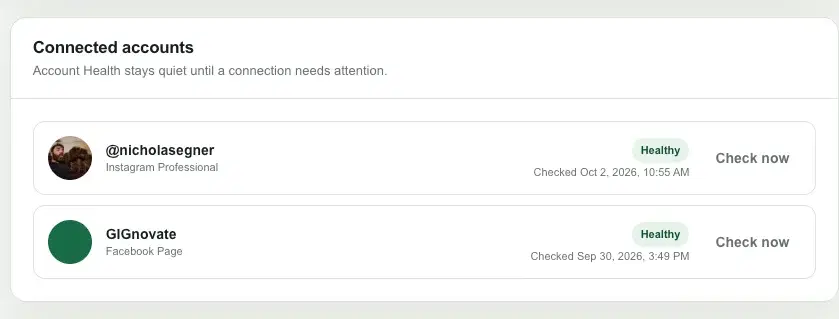
That was an important milestone.
The application doesn’t need to be completely finished before it becomes useful. I can actually use it while I continue building it.
Building the Scheduling System
Once I could publish something immediately, the next problem was figuring out how to reliably publish something later.
Behind the scenes, I’m using AWS EventBridge and Lambda to handle scheduling and automation.
I don’t need the person using the hub to know—or care—how any of that works. They should just be able to choose a date and time and trust that the post will go out.
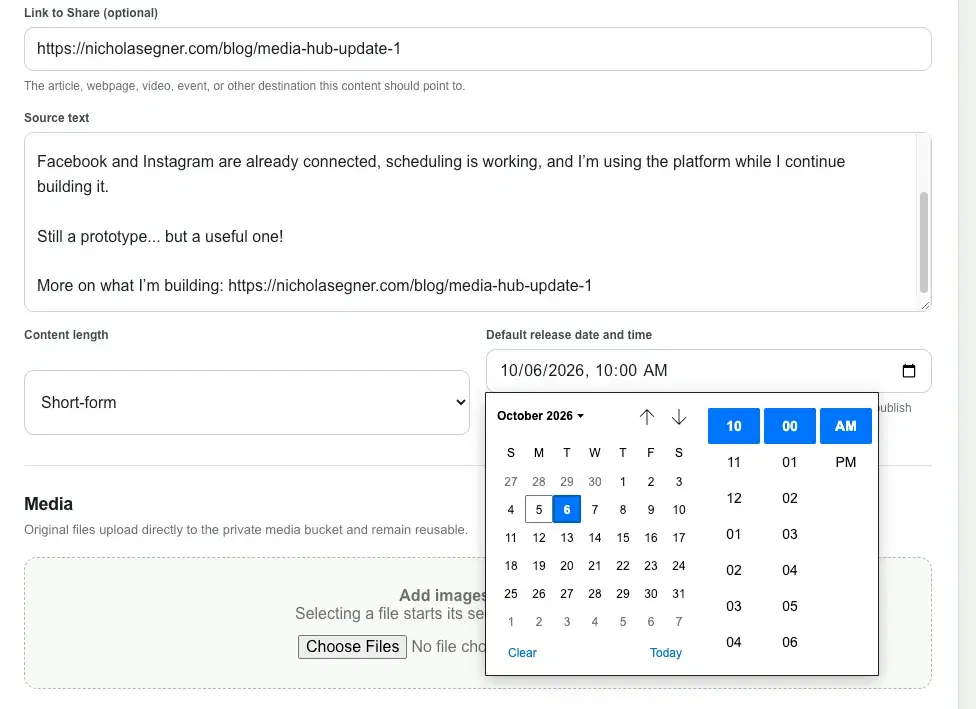
But getting that apparently small feature working means connecting several different pieces behind the scenes.
That’s been another interesting part of the project: taking something technically complicated and trying to make the experience on the other side feel extremely straightforward.
What’s Next
Facebook and Instagram are only the beginning.
Some of the next major connections I’m working toward are:
Google Business
LinkedIn
YouTube
Blog publishing
Maybe TikTok... if I can figure that one out.... I hear there might not be a straight forward connection with that.
I’m especially interested in the blog side of it.
A longer piece of content could potentially become the starting point for several smaller social posts, videos, updates, or other pieces of content—all managed from the same place.
Longer term, I also see the possibility of giving clients their own logins so they can access and manage parts of the system themselves.
There are a lot of directions this could go. For now, though, I’m trying to build the version that solves the problem directly in front of me: managing more content and more accounts without creating more administrative work.
Building It While Using It
That might be my favorite part of this project so far. It isn’t something I’m building in isolation and hoping becomes useful later. I’m already using it.
Every time I publish something, connect another account, or find another annoying part of the workflow, I learn something that changes what I build next.
So I’m going to start sharing more of that process as the project develops. The things that work, the things that don’t, and some of the decisions happening along the way.
This is still very much a prototype. But it’s becoming a useful one!